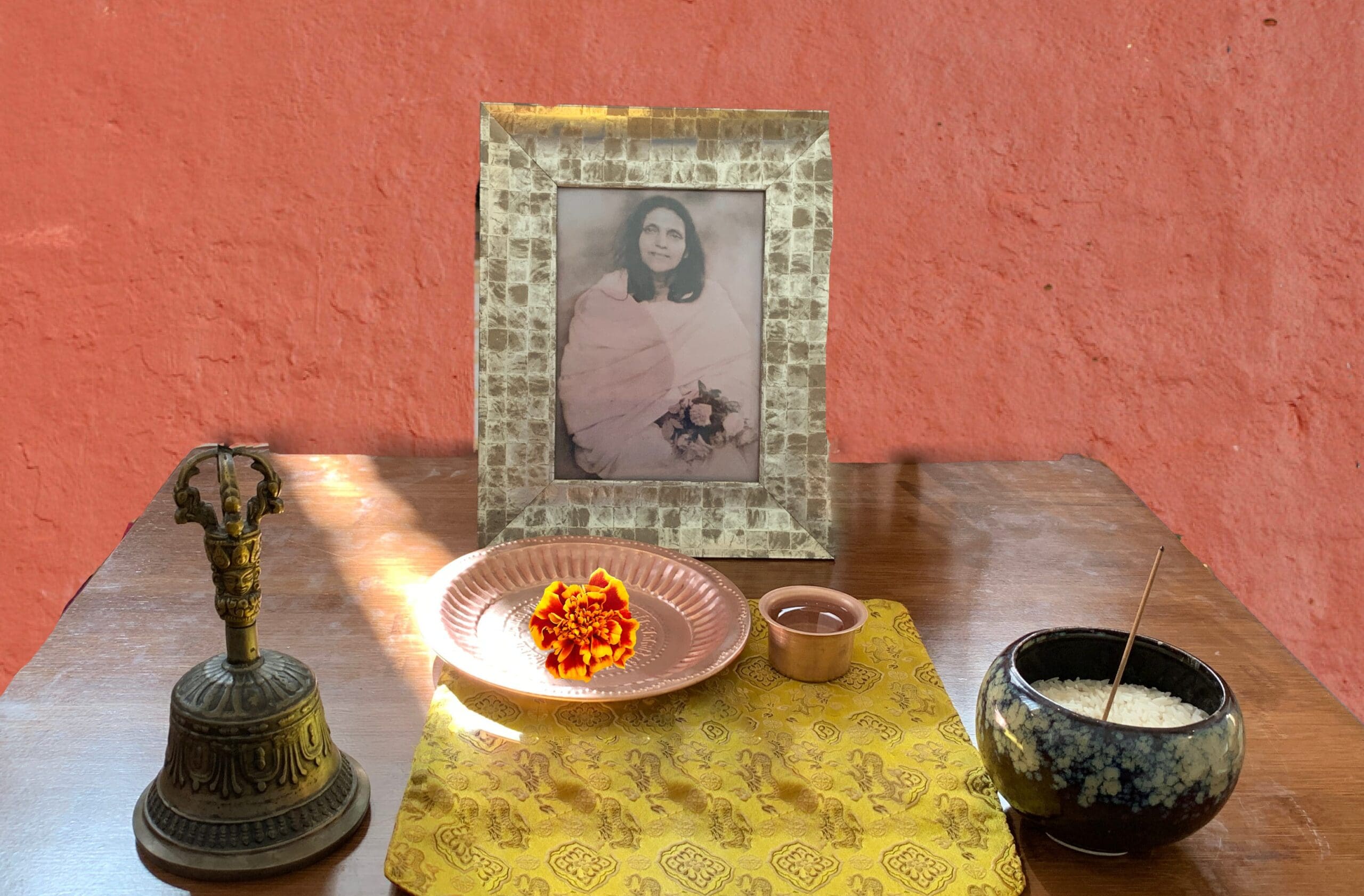


108 Names of Anandamayi Ma Kirtan Chant Video

We’re just a bunch of Anandamayi Ma geeks. And that’s why, every first Saturday of the month, we spend an hour or so chanting Anandamayi Ma’s 108 names to a beautiful tune taught to us by our friend, Swamini Brahmananda.

The names were compiled by Ma’s disciple, Jyotish Chandra Roy, aka, Bhaiji. If you want to chant along, download the PDF of the names with their translations. 

Enjoy!

What are Spiritual Organizations for?

Ideally, a spiritual organization should function as another field of sadhana, a vehicle for Self-realization and nothing else. 

Swami Satyananda Saraswati, the head of my diksha lineage, founded many organizations, including the world’s first PhD-granting yoga university. He said that spending his days signing papers was not the life he envisioned, but he found himself doing just that.

Swami Satyananda

Swami Satyananda Saraswati

On the evening after his death, I dreamt that he was gleefully giving away his last remaining possessions, including large pieces of furniture. These were symbols of the gross structures he felt it necessary to maintain for the benefit of others while he was in that body.

A good number of spiritual teachers found organizations, buy property and work hard at developing governance structures for their organizations. The structure and relative stability of organizations makes it easier for some teachers to serve people. Many times, organizations are formed with the intention that they function as vehicles for preserving teachings and lineage.

But within every spiritual organization I have encountered are people who form unhealthy attachments to the organization itself. They become rigid rule-keepers and earnestly over-emphasize their role in upholding and protecting the organization. Sometimes people set themselves up as gatekeepers when no one has actually asked them to take on that function.

People can become more attached to organizations and rules and position than they are to Self-realizing.

Leaving that aside, nearly everyone in spiritual organizations projects ordinary world concepts onto the organization.

The Board of Jaya Kula regularly has to regularly remind itself that we are not trying to grow. Nor are we trying not to grow. Our job is to serve the people who show up as best as we can, whether it be a few people or a few hundred people, or more.

But due to deep cultural conditioning, the simple fact of having an organization keeps flipping on the “we must grow” switch.

One time, a Board member planned a seva event. Only two other people attended, so she canceled. It wasn’t “worth it” unless more people showed up. In reality, her ego was bruised.

I reminded her that six years ago, there were only a handful of people coming to teachings. If I had canceled the teachings, none of us would be here together now.

Recently, we organized the Crucible. The Crucible is responsible for the seva, or service activities of Jaya Kula. It is made up of  five Crus. Each Cru works in a different area.

The Crus are:

  • Red Cru: Communications – our newsletter, webcasts, website and other tech stuff
  • Blue Cru: Teachings – setting up and serving as hosts for the teachings
  • Yellow Cru: Kashi House – gardening, improvements to Kashi House
  • Purple Cru: Pujas, special events and the Majesty Club (where we dress up and celebrate life’s majesty!)
  • Green Cru: Personal service to the teacher and the community at large.

At our meetings, I remind people that Jaya Kula is not important. The Crus are not important. The only reason for these to exist is as a field for the playfulness we call spiritual practice.

Many decades ago, when flooding caused the Varanasi Anandamayee Ma ashram to partially collapse into the Ganga, Ma herself just laughed. 

Dunga Lingam

Ruined temple with blue lingam in Dunga, Uttar Pradesh. Anandamayi Ma once stayed here.

While organizing and offering seva, we  do our best to keep the focus on relaxing and waking up. We try to remember to laugh at ourselves if we start generating a sense of urgent self-importance about our activities, the Crus or Jaya Kula itself.

When people freak out, we work with that as people experiencing freaking out and nothing more. We know that on one level, there is never anything to freak out about. Everything is Lord Shiva at play.

As Swami Laksmanjoo said: Seva does not mean that you will cook food for your Master. That is not seva. Seva means abhyasena [being in the state of your practice]. When you try to stay in that state of God consciousness–that is seva.

My Sat Guru, Anandamayi Ma, offered this guidance:

In this world do not become an owner, become a gardener. All problems occur when you become an owner. There are no fights if you can become a mere gardener. The world belongs to the Lord; I am only the servant, that is all. I will keep on serving according to His orders. If you can always live the life of a householder with this emotion, no new bonds will be forged. 

Jaya Kula 2013 Pilgrimage to India and Bangladesh

Please join Shambhavi Sarasvati and Jaya Kula for a once-in-a-lifetime journey through Shakta Tantrik West Bengal in India, and Bangladesh. We will be visiting and practicing in some of the most ancient and active Tantrik sites and making a pilgrimage to places where the great Bengali avatar and teacher, Anandamayi Ma, was born, walked, and taught.

The dates of the Yatra (pilgrimage) are December 15th, 2013 to January 1, 2014.

Visit the Yatra page for more information and to download a Yatra guide and application for this extraordinary journey!


Imitation is not always Flattering

Many of my teachers have been quite fierce. But their fierceness has always been held in the crucible of their kindness and compassion. At times there can even be a fundamental gentleness displayed just as a teacher is decimating some fixation with fierce, cutting-through energy.

Spiritual communities tend to take on some of the personality flavor of their preceptors. Direct realization traditions tend to attract both fierce, or crazy wisdom teachers and ambitious students. What happens when you mix the two? Well, you sometimes get students who crave the power of the teacher in order to support the fixations of small I. They may imitate the fiercer aspects of the teacher, while having as of yet little access to the spontaneous gentleness, compassion and kindness of the teacher.

If you want to imitate your teacher, try imitating your teacher’s gentleness, sweetness and respect for all people, not your teacher’s fierceness. It is always better to do a bad imitation of gentleness and unconditioned respect than a bad imitation of fierceness.

Love,

Shambhavi